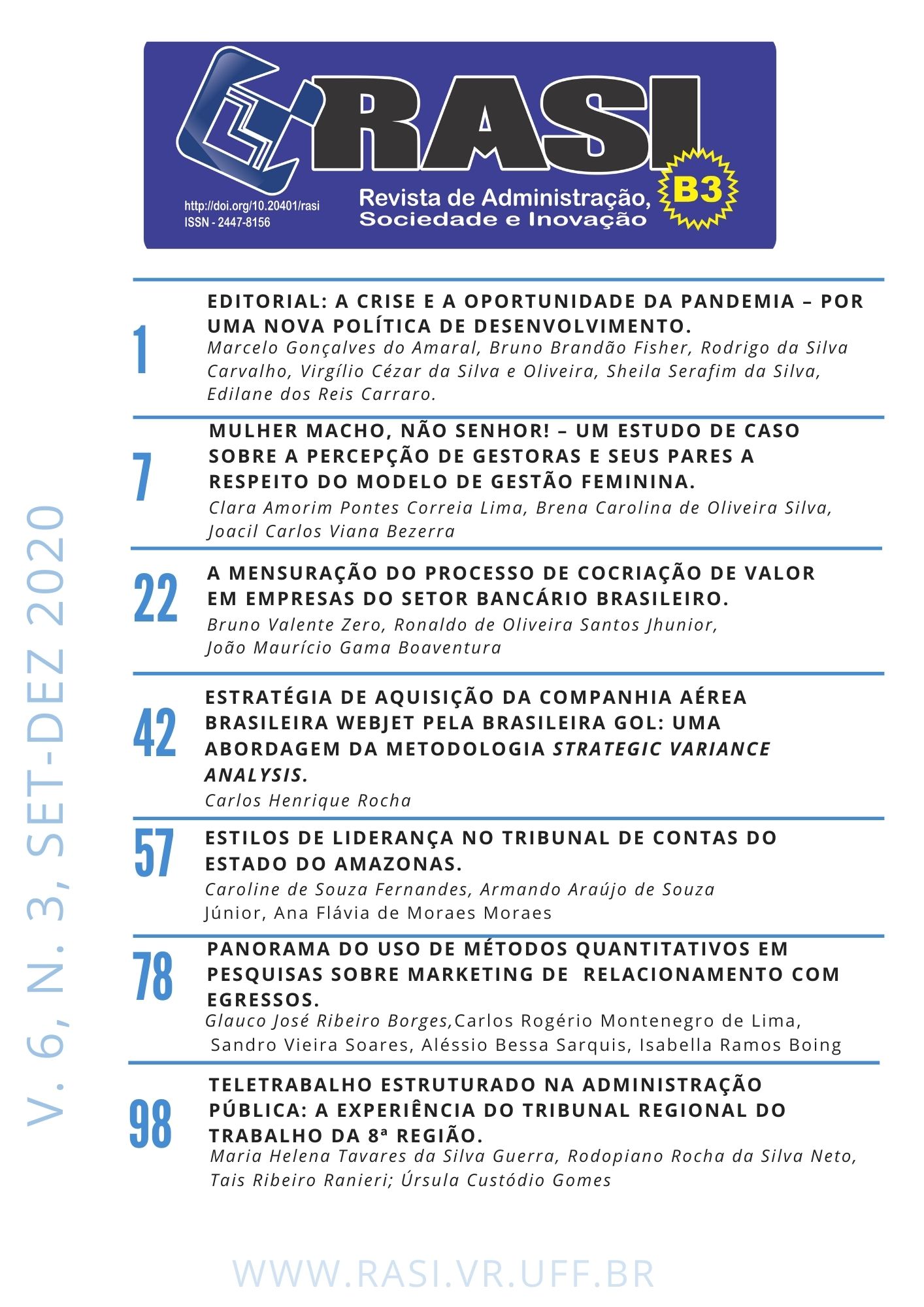
Structured Telework in Public Administration:
An Experience of the 8th Regional Labor Court
DOI:
https://doi.org/10.20401/rasi.6.3.465Keywords:
Telework, Public Service, Judicial PowerAbstract
There is a growing interest in teleworking in public administration. In this context, this article aims to critically report the experience of “Structured Telework” within the 8th Regional Labor Court (TRT8), as a strategic initiative that contributes to achieving the institutional future vision, seeking a balance between productivity and organizational climate. After situating the main theoretical aspects on the theme, a brief diagnosis of the problem situation is outlined, which led to the development of the project to improve the dynamics of teleworking in the Court. Then, we present the proposed intervention, which aimed to structure the regime, promoting good management practices, through the promotion of training events, in addition to other incentive actions and support for telework, anchored in the sponsorship of Senior Management. The main verified results are presented, especially with regard to the significant increase in adherence to the regime, the satisfaction of civil servants and managers with the adoption of the practice and the consequent improvement in productivity and climate indicators. Finally, possible technological-social contributions are discussed and important reflections and recommendations are made.
Downloads
Downloads
Published
Issue
Section
License
Copyright (c) 2020 Review of Administration, Society and Innovation

This work is licensed under a Creative Commons Attribution 4.0 International License.
RASI, in accordance with Law No. 9,610 of February 19, 1998, which amends, updates and consolidates Brazilian copyright law and makes other provisions, adopts the following conditions of the Copyright Assignment:
1. RASI maintains, with the transfer of copyrights, the possession of rights over the content published;
2. The author retains his moral rights of the content, including the right to be identified as the author whenever the content is published;
3. Despite the attribution of copyright, the author retains the right to reuse the material in future collections of his own work without encumbrance. The acknowledgments of the previous publication in the RASI are the only requirements in such cases;
4. The author may make photocopies of the content, or distribute it by electronic mail or fax, provided that they are intended for their own classes and for the purpose of meeting research objectives, provided that: (a) such copies are not resold and (b) reference to the original source of the publication and the name of the RASI are clearly indicated on all copies made of the document.