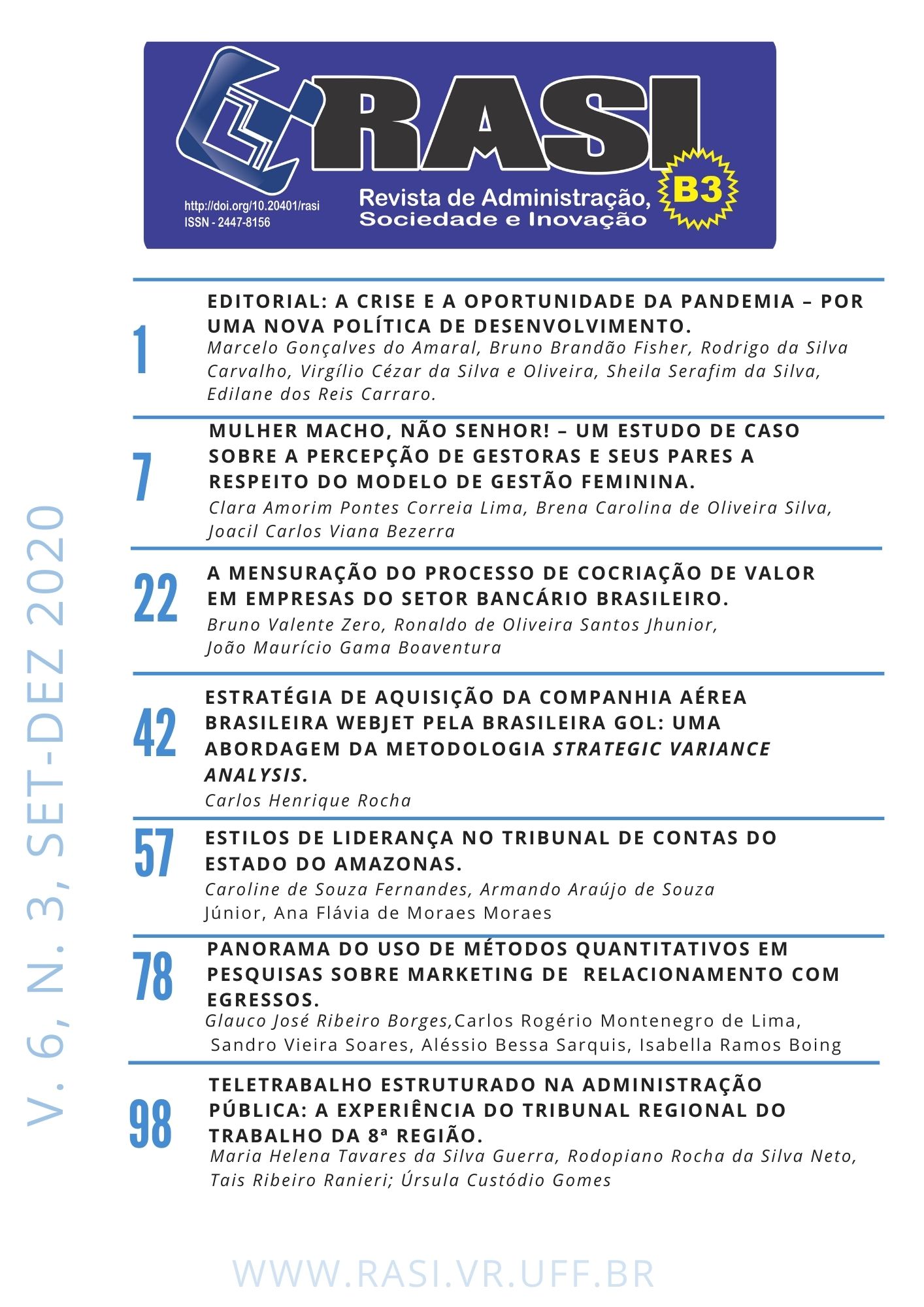
Overview of the Use of Quantitative Methods in Research on Relationship Marketing with Alumni
DOI:
https://doi.org/10.20401/rasi.6.3.451Keywords:
Quantitative methods, Statistics, Marketing of relationship, AlumniAbstract
The study maps an overview of the quantitative methods used in research on relationship marketing with alumni. It is a bibliographic study, with bibliometric analysis, which analyzed a bibliographic portfolio of 20 papers published until 2018 on the subject. The results show that most publications on the subject use structural equation modeling, confirmatory factor analysis and descriptive statistics. Cronbach's alpha is the most used scale reliability analysis. The two variables most analyzed in studies on the subject are university image and satisfaction, terms supported by the literature in the area. The study contributed to broaden the understanding about the use of quantitative methods in research on the subject and to point out some directions that may help in future studies.
Downloads
Downloads
Published
Issue
Section
License
Copyright (c) 2020 Review of Administration, Society and Innovation

This work is licensed under a Creative Commons Attribution 4.0 International License.
RASI, in accordance with Law No. 9,610 of February 19, 1998, which amends, updates and consolidates Brazilian copyright law and makes other provisions, adopts the following conditions of the Copyright Assignment:
1. RASI maintains, with the transfer of copyrights, the possession of rights over the content published;
2. The author retains his moral rights of the content, including the right to be identified as the author whenever the content is published;
3. Despite the attribution of copyright, the author retains the right to reuse the material in future collections of his own work without encumbrance. The acknowledgments of the previous publication in the RASI are the only requirements in such cases;
4. The author may make photocopies of the content, or distribute it by electronic mail or fax, provided that they are intended for their own classes and for the purpose of meeting research objectives, provided that: (a) such copies are not resold and (b) reference to the original source of the publication and the name of the RASI are clearly indicated on all copies made of the document.