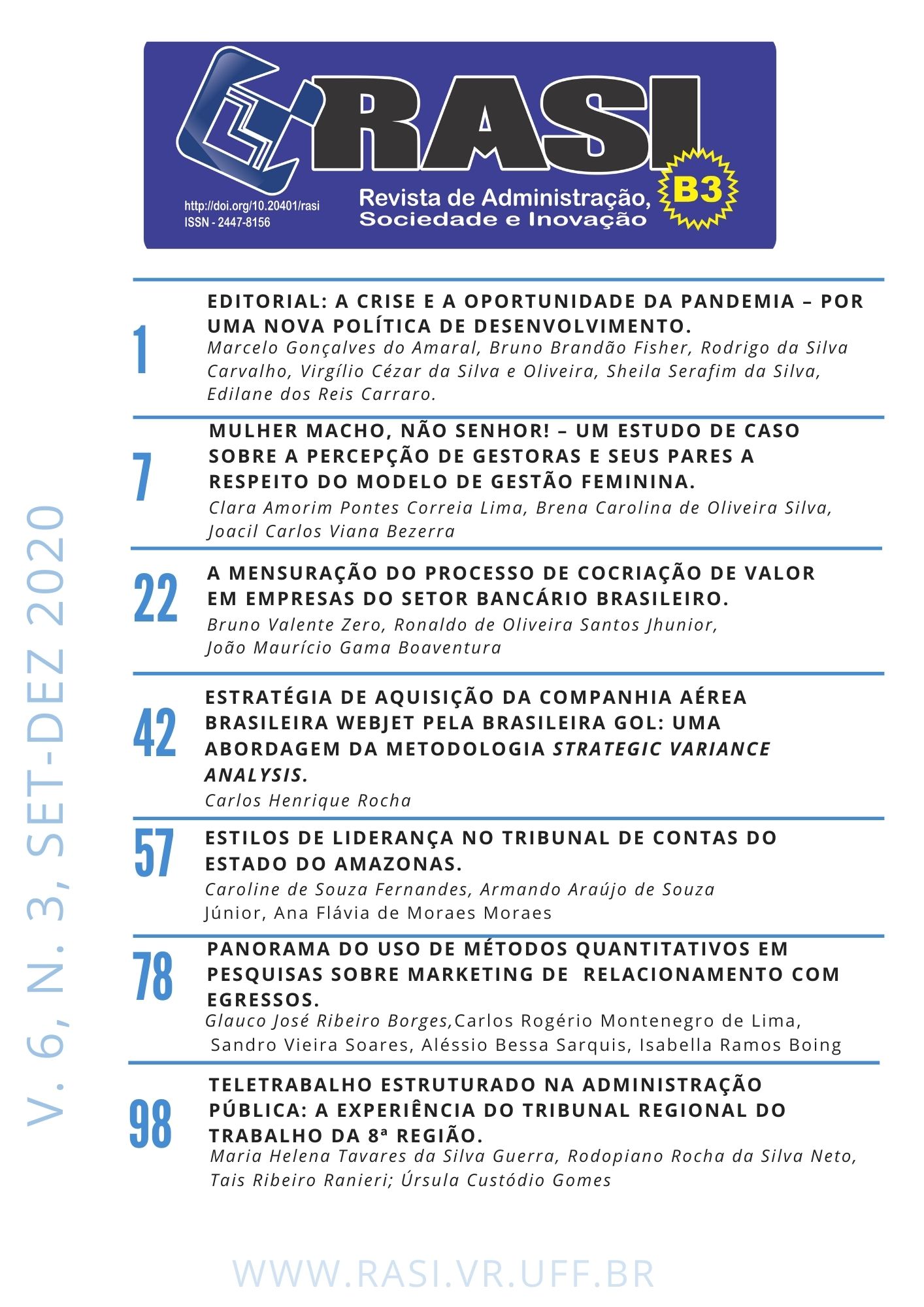
The Measurement Of The Value Co-Creation Process In Brazilian Banking Sector Companies
DOI:
https://doi.org/10.20401/rasi.6.3.428Keywords:
Value, Value creation, Value co-creation, Bank sectorAbstract
The emerging reality based on greater access to information, technological convergence, and the rapid evolution of the internet as a means of communication and conducting business, requires a reevaluation of the traditional enterprise-centric value creation system. This article addresses the idea of ??value co-creation, in which value is no longer defined within the company and only delivered to the consumer, but rather created jointly with stakeholders in a process focused on individuals and their experiences. Thus, the study seeks to expand knowledge about value co-creation in Brazilian companies based on empirical information. Therefore, the objective of the research is to measure value co-creation in companies in the Brazilian banking sector and to compare performance between them. The DART model (dialogue, access, risk, and transparency) proposed by Prahalad & Ramaswamy (2004) is used as the basis for the analysis of data obtained from the Corporate Sustainability Index (BM&F-ISE) of 2017. The results show the highlight of one of the analyzed banks, as well as the fact that the analyzed companies still need a greater focus on the development of factors related to the “access” dimension of the model used.
Downloads
Downloads
Published
Issue
Section
License
Copyright (c) 2020 Review of Administration, Society and Innovation

This work is licensed under a Creative Commons Attribution 4.0 International License.
RASI, in accordance with Law No. 9,610 of February 19, 1998, which amends, updates and consolidates Brazilian copyright law and makes other provisions, adopts the following conditions of the Copyright Assignment:
1. RASI maintains, with the transfer of copyrights, the possession of rights over the content published;
2. The author retains his moral rights of the content, including the right to be identified as the author whenever the content is published;
3. Despite the attribution of copyright, the author retains the right to reuse the material in future collections of his own work without encumbrance. The acknowledgments of the previous publication in the RASI are the only requirements in such cases;
4. The author may make photocopies of the content, or distribute it by electronic mail or fax, provided that they are intended for their own classes and for the purpose of meeting research objectives, provided that: (a) such copies are not resold and (b) reference to the original source of the publication and the name of the RASI are clearly indicated on all copies made of the document.